Ethernet Cable Colour Code PDF: A Comprehensive Guide
Navigating Ethernet cabling requires understanding colour codes; PDFs offer detailed charts for T-568A, T-568B, and telephone wire identification, ensuring correct connections․

Ethernet cable colour codes are fundamental to establishing reliable network connections․ These standardized wiring schemes, often detailed in readily available PDF resources, dictate the arrangement of individual wires within a cable․ Understanding these codes – primarily T-568A and T-568B – is crucial for creating both straight-through and crossover cables․ The colour coding isn’t arbitrary; it’s designed to minimize signal interference, ensuring optimal data transmission speeds․
PDF guides typically illustrate pair arrangements, like Blue/White-Blue, and overall cable specifications, including diameter and filler materials (spline)․ They also cover telephone wire identification charts (50-pair) and ICEA standards․ Proper adherence to these colour codes is vital for troubleshooting and maintaining network integrity, preventing connectivity issues stemming from incorrect wiring․ These resources are essential for both professionals and DIY enthusiasts․
Why Colour Codes Matter in Ethernet Cabling
Colour codes in Ethernet cabling aren’t merely for organization; they are integral to signal integrity․ Twisting wires in pairs, each with a specific colour scheme, minimizes electromagnetic interference (EMI) and crosstalk – disruptions that degrade data transmission․ PDF guides detail how consistent colour arrangements maintain impedance control, crucial for high-speed networks․
Incorrect wiring disrupts these pairings, leading to packet loss, slow speeds, and unreliable connections․ Standardized schemes like T-568A and T-568B, documented in colour code PDFs, ensure compatibility between devices․ Furthermore, colour coding simplifies troubleshooting; a visual inspection can quickly identify wiring errors․ Adhering to these standards, and referencing available PDF resources, guarantees a stable and efficient network infrastructure․
Understanding T-568A and T-568B Standards
T-568A and T-568B are the two primary wiring standards for Ethernet cables, both detailed in readily available colour code PDFs․ T-568A utilizes a white/green-green, white/orange-orange, white/blue-blue, and white/brown-brown pairing sequence․ Conversely, T-568B swaps the orange and green pairs: white/orange-orange, white/blue-blue, white/green-green, and white/brown-brown․
While both function correctly, consistency is key․ Typically, T-568B is more common in North America, while T-568A sees greater use elsewhere․ PDF resources emphasize using the same standard at both ends of a straight-through cable for standard network connections․ Crossover cables, however, require one end wired to T-568A and the other to T-568B, a detail clearly illustrated in comprehensive colour code PDFs․
T-568A Wiring Scheme: Detailed Breakdown
The T-568A standard, thoroughly documented in Ethernet cable colour code PDFs, dictates a precise wiring order․ Pair 1 consists of white/green and green wires, crucial for transmitting and receiving data signals․ Pair 2 utilizes white/orange and orange, continuing the signal pathway․ Pair 3 employs white/blue and blue, maintaining consistent performance․ Finally, Pair 4 is comprised of white/brown and brown wires, completing the eight-wire configuration․
PDF guides highlight the importance of maintaining twist rates throughout the cable length to minimize interference․ Correctly following this scheme ensures optimal network speed and reliability․ Colour code charts within these PDFs visually represent this order, simplifying the wiring process for technicians and DIY enthusiasts alike, guaranteeing a functional Ethernet connection․
Pair 1: White/Green ‒ Green
Within both T-568A and T-568B standards, as detailed in Ethernet cable colour code PDFs, Pair 1 consistently utilizes white/green and green wires․ This pairing is fundamental for establishing a reliable data transmission path․ PDFs emphasize the importance of maintaining the correct twist rate between these wires to minimize crosstalk and signal degradation․
Proper termination of this pair is critical for network performance․ Colour code charts within these PDFs clearly illustrate the order, aiding technicians in accurate wiring․ Incorrectly wiring Pair 1 can lead to connectivity issues or reduced network speeds․ Consistent adherence to the white/green-green sequence, as shown in the documentation, is paramount for a functional Ethernet cable․
Pair 2: White/Orange — Orange
Ethernet cable colour code PDFs consistently identify white/orange and orange as the designated wires for Pair 2 in both T-568A and T-568B wiring schemes․ This pair, like others, relies on consistent twisting to reduce electromagnetic interference (EMI) and maintain signal integrity․ Detailed charts within these PDFs visually demonstrate the correct sequence for termination․
Accurate wiring of Pair 2 is crucial for successful network operation․ Miswiring can result in intermittent connectivity or significantly reduced bandwidth․ Technicians rely on these colour-coded guides to ensure proper connections․ The documentation highlights that maintaining the specified twist rate is as important as the colour order itself, contributing to optimal performance and minimizing signal loss․
Pair 3: White/Blue, Blue
Colour code PDFs clearly illustrate white/blue and blue wires forming Pair 3, a fundamental component in Ethernet cabling standards․ This pair’s consistent placement is vital for maintaining signal transmission quality and minimizing crosstalk․ The documentation emphasizes that correct identification and termination of this pair are essential for reliable network performance․
These PDFs often showcase diagrams detailing the precise order within both T-568A and T-568B configurations․ Proper twisting of these wires is also highlighted, as it’s critical for reducing interference․ Technicians frequently consult these resources to avoid common wiring errors that can lead to connectivity issues or reduced bandwidth․ Accurate adherence to the colour code ensures optimal data transfer speeds and network stability․
Pair 4: White/Brown — Brown
Ethernet cable colour code PDFs consistently depict white/brown and brown wires as constituting Pair 4, a crucial element in both T-568A and T-568B wiring schemes․ These resources emphasize the importance of correctly identifying and terminating this pair to guarantee optimal network functionality․ Maintaining the correct twist rate during cable construction and termination is also highlighted within these guides․
PDFs often include detailed diagrams illustrating the precise positioning of Pair 4 within the overall cable structure․ Incorrect wiring of this pair can lead to signal degradation and network instability․ Technicians rely on these visual aids to avoid common mistakes and ensure reliable data transmission․ Adhering to the specified colour code minimizes interference and maximizes network performance, as detailed in comprehensive cabling documentation․
T-568B Wiring Scheme: Detailed Breakdown
Ethernet cable colour code PDFs prominently feature the T-568B standard, widely adopted for its compatibility․ This scheme begins with white/orange and orange as Pair 1, followed by white/blue and blue for Pair 2․ Pair 3 consists of white/green and green, while the final Pair 4 utilizes white/brown and brown․ These PDFs provide clear diagrams illustrating the precise wire order for termination․
Understanding T-568B is crucial for creating straight-through cables, commonly used for connecting different network devices․ Colour code charts within these documents emphasize consistent adherence to the sequence․ PDFs also detail the importance of maintaining proper twist rates to minimize crosstalk․ Correct implementation of T-568B, as outlined in these guides, ensures reliable network connectivity and optimal performance․
Pair 1: White/Orange ‒ Orange
Ethernet cable colour code PDFs consistently identify white/orange and orange as the foundational pairing for both T-568B and, crucially, as the reversed starting point for T-568A․ These documents emphasize the importance of correctly identifying these wires, often highlighting them in diagrams․ Accurate placement of this pair is paramount for establishing a functional network connection․
PDF guides detail that this pairing typically handles transmit and receive signals․ Maintaining the correct order – white stripe facing outwards – is vital․ Colour code charts within these resources visually demonstrate the proper arrangement․ Miswiring this pair can lead to connectivity issues or signal degradation․ Therefore, careful attention to detail, as illustrated in these PDFs, is essential for successful cable termination․
Pair 2: White/Blue ‒ Blue
Ethernet cable colour code PDFs universally showcase white/blue and blue as the second twisted pair, following the white/orange and orange sequence in T-568B․ Conversely, in T-568A, this pair shifts position․ These PDFs often feature magnified images illustrating the subtle colour variations, aiding accurate identification․ Correctly distinguishing between blue and blue-white is crucial, as misidentification leads to network malfunctions․
These resources emphasize that this pair commonly handles data transmission․ PDF guides detail the importance of maintaining consistent twisting throughout the cable length to minimize interference․ Colour-coded charts within these documents provide a clear visual reference for proper wiring․ Proper termination of this pair, as demonstrated in the PDFs, ensures optimal signal integrity and reliable network performance․
Pair 3: White/Green ‒ Green
Ethernet cable colour code PDFs consistently depict white/green and green as the third twisted pair, a key component in both T-568A and T-568B standards, though their order differs․ These PDFs often include detailed diagrams showing the precise arrangement within the connector․ Accurate identification of these colours is paramount for successful cable termination, preventing signal degradation and connectivity issues․
PDF resources highlight that this pair frequently carries crucial data signals․ Maintaining consistent twisting is emphasized to minimize electromagnetic interference (EMI)․ Colour-coded charts within these guides provide a quick visual reference for technicians․ Proper termination, as illustrated in the PDFs, ensures optimal network performance and reliable data transfer․ These documents also stress the importance of avoiding colour swapping․
Ethernet cable colour code PDFs universally identify white/brown and brown as the fourth twisted pair, vital for both T-568A and T-568B wiring schemes, though their positions vary․ These PDFs often feature clear illustrations demonstrating correct placement within RJ45 connectors․ Precise colour recognition is essential for preventing network malfunctions and ensuring stable connections․
PDF guides emphasize that this pair typically handles power over Ethernet (PoE) in compatible setups․ Consistent twisting throughout the cable length is crucial for minimizing crosstalk and maximizing signal integrity, as detailed in the resources․ Colour-coded charts within these documents serve as a quick reference for installers․ Correct termination, as shown in the PDFs, guarantees optimal network speed and reliability, avoiding potential data loss․
Straight-Through vs․ Crossover Cables
Ethernet cable colour code PDFs clearly delineate the wiring differences between straight-through and crossover cables․ Straight-through cables, utilizing either T-568A or T-568B on both ends, are standard for connecting dissimilar devices – like a computer to a switch․ Conversely, crossover cables swap the transmit and receive wires (typically pairs 1 & 3) at one end, connecting similar devices directly․
PDF guides illustrate these configurations with diagrams, emphasizing the importance of selecting the correct cable type․ Modern network devices often auto-sense, reducing the need for crossover cables, but understanding the principle remains vital․ Colour code charts within these resources help verify proper wiring․ Incorrect cable selection leads to connectivity issues, highlighted in troubleshooting sections of the PDFs․
Identifying Cable Types: Solid vs․ Stranded
Ethernet cable colour code PDFs often detail the distinction between solid and stranded conductors․ Solid core cables feature a single, continuous copper strand per wire, ideal for permanent installations and longer runs due to lower attenuation․ Stranded cables comprise multiple thinner wires bundled together, offering greater flexibility – suited for patch cables and frequent movement․

PDF resources emphasize that colour coding remains consistent regardless of conductor type, but handling differs․ Solid core is more brittle, while stranded is less prone to breakage from bending․ Cable specifications within these guides will indicate conductor type․ Choosing the appropriate cable impacts performance and longevity; PDFs aid in informed selection based on application needs․

Colour Codes for Telephone Wire Identification (50 Pair Chart)
While primarily focused on Ethernet, comprehensive colour code PDFs sometimes include charts for identifying telephone wire pairs․ These charts detail a 50-pair system, utilizing colour combinations for each pair – crucial for legacy telephone systems and complex wiring scenarios․ Cable pairs are typically black and white, numbered 1 through 25, while triads use black, white, and red, numbered 26 to 50․
These charts, often referencing ICEA standards, are valuable when integrating older infrastructure with modern Ethernet networks․ Understanding these codes aids in troubleshooting and maintaining combined systems․ PDFs highlight the importance of accurate identification to prevent cross-talk and ensure proper signal transmission within telephone lines․
ICEA Standard Cable Pair and Triad Colour Coding
ICEA (Insulated Cable Engineers Association) standards define colour coding for telephone and communication cables, often referenced within Ethernet cable colour code PDFs․ Pair cables typically utilize black and white insulation, numbered sequentially from 1 to 25․ This provides a clear identification system for individual circuits within a larger cable bundle․
Triad cables, containing three insulated conductors, employ black, white, and red insulation, numbered 26 through 50; Adherence to these ICEA standards is vital for maintaining consistency and facilitating efficient troubleshooting․ Detailed PDFs will often include tables mapping these numbers to specific colour combinations, ensuring correct wiring and minimizing signal interference․ Proper ICEA compliance is key for reliable network performance․
Using Colour-Coded Connectors for Quick Splices
Colour-coded connectors streamline Ethernet cable splicing, eliminating the need for traditional stripping, twisting, and soldering techniques․ These connectors, often featured in Ethernet cable colour code PDFs as helpful tools, provide pre-insulated connections for faster, more reliable results․ They simplify field terminations, reducing the risk of errors and improving overall installation efficiency․
Utilizing these connectors is particularly beneficial for quick repairs or extending existing cable runs․ The colour coding on the connectors corresponds to standard wiring schemes (T-568A/B), guiding users to the correct configuration․ PDFs often showcase these connectors, highlighting their ease of use and contribution to a cleaner, more professional cabling setup․ They are a valuable asset for both professionals and DIY enthusiasts․
Ethernet Cable Jacket Colour and its Significance
While the internal wire colour code is crucial for signal transmission, the Ethernet cable jacket’s colour primarily serves identification and organizational purposes․ Ethernet cable colour code PDFs don’t typically detail jacket significance for performance, but rather for network management․ Common jacket colours include blue, grey, white, and yellow, often used to differentiate cable types or network segments․

For instance, blue is frequently associated with standard Ethernet cables, while grey might indicate a riser-rated cable․ White jackets are often used in plenum spaces․ Understanding these conventions, often referenced in comprehensive PDF guides, aids in troubleshooting and future upgrades․ The jacket colour doesn’t affect data transmission but simplifies cable tracing and maintenance within complex network infrastructures․
Overall Cable Diameter and Fillers (Spline)
Ethernet cable colour code PDFs often include specifications beyond just wire arrangements, detailing the overall cable dimensions․ Common diameters, like 0․365 x 0․165 inches, are frequently listed, impacting bend radius and installation within conduits․ Fillers, known as spline, are central components providing structural support and maintaining cable roundness․
These spline fillers, typically made of insulating material, prevent wire distortion and ensure consistent electrical characteristics․ PDFs will specify the spline’s material and quantity․ Understanding these physical properties, alongside the colour code, is vital for proper cable handling and performance․ Incorrect bending or compression can degrade signal quality, so referencing these specifications within a PDF guide is crucial for professional installations․
CA Prop 65 and China RoHS Compliance (MII Order 39)
Comprehensive Ethernet cable colour code PDFs increasingly incorporate regulatory compliance information․ California Proposition 65 (CA Prop 65) details potential exposure to chemicals known to cause cancer or reproductive harm, requiring warnings if present in the cable materials․ Similarly, China’s Restriction of Hazardous Substances (RoHS) directive, specifically MII Order 39, limits the use of certain hazardous materials like lead, mercury, and cadmium․
PDF documentation will often state “Yes” for CA Prop 65 compliance or indicate adherence to MII Order 39, assuring users of environmental and health safety standards․ This information is vital for businesses importing or selling cables, ensuring legal compliance and responsible sourcing․ Checking these details within the PDF confirms the cable meets required regulations․
Keystone Jack Colour Labels: A and B Standards
Ethernet cable colour code PDFs frequently reference ‘A’ and ‘B’ standards found on keystone jack labels․ These labels directly correlate to the T-568A and T-568B wiring schemes, respectively․ Understanding this is crucial for maintaining consistent connectivity throughout a network․ A keystone jack’s label indicates which wiring standard the port is punched down to․
Using the wrong standard – mismatching the cable wiring to the jack label – results in a non-functional connection․ PDFs often visually depict these labels, clarifying which colour combinations correspond to ‘A’ (typically green pair first) and ‘B’ (typically orange pair first)․ Accurate matching, guided by the PDF, ensures reliable data transmission and network performance․
Troubleshooting Colour Code Issues
When network connectivity fails, colour code discrepancies are often the culprit․ Ethernet cable colour code PDFs become invaluable troubleshooting tools․ Begin by verifying that both ends of the cable adhere to the same standard – either T-568A or T-568B – as detailed in the PDF․ Incorrect wiring, even a single swapped pair, disrupts signal transmission․
Inspect each wire within the RJ45 connectors, comparing them against the PDF’s diagrams․ Look for loose connections, improperly seated wires, or colours that don’t match the chosen standard․ A PDF can help identify if a straight-through or crossover cable is needed for the specific application․ Systematic checking, guided by a colour code PDF, quickly isolates and resolves these common network issues․
Tools for Working with Ethernet Cables and Colour Codes
Effective Ethernet cable installation and troubleshooting require specific tools․ A quality cable stripper precisely removes the jacket without damaging the internal wires․ Crimpers securely attach RJ45 connectors, ensuring reliable connections․ A cable tester verifies continuity and confirms correct wiring according to T-568A or T-568B standards, referencing a colour code PDF․
Punch-down tools are essential for terminating cables onto keystone jacks, while colour-coded connectors simplify quick splices, eliminating the need for soldering․ Having a readily available Ethernet cable colour code PDF is crucial for visual guidance during wiring․ These tools, combined with a clear understanding of colour codes, empower technicians to create and maintain robust network infrastructure․
Reading Ethernet Cable Colour Code Charts (PDF Resources)
Ethernet cable colour code charts, often found in PDF format, are vital for correct termination․ These charts visually represent the wiring configurations for T-568A and T-568B standards, displaying the precise order of coloured wires within the RJ45 connector․ Understanding the pairing – white/blue, blue, white/orange, orange, etc․ – is key․
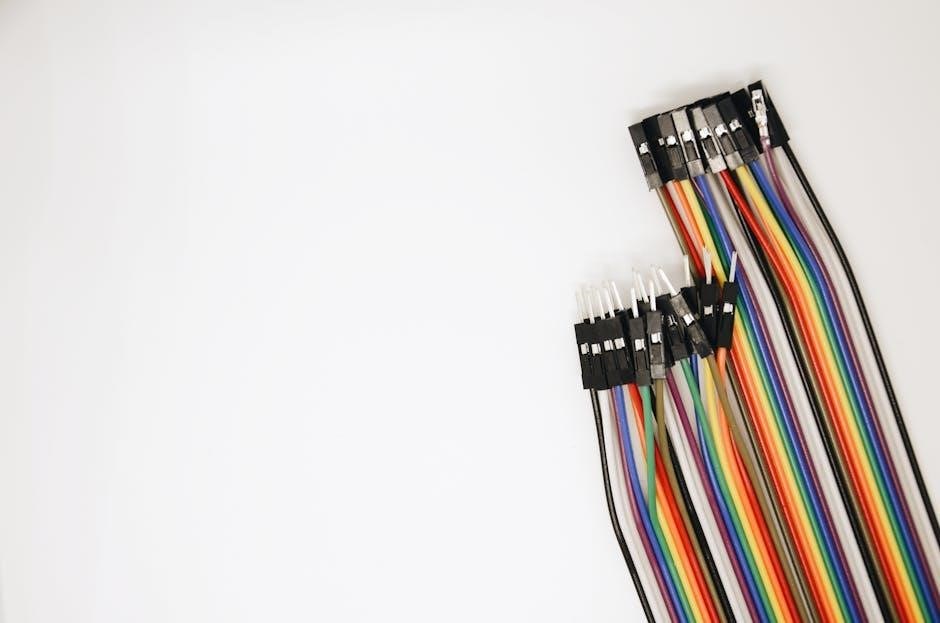
PDF resources also detail colour codes for telephone wire identification (50-pair charts) and ICEA standards․ When reading, focus on matching the wire colours to the corresponding positions․ Proper interpretation prevents signal interference and ensures network functionality․ Downloadable PDFs provide a portable reference for on-site installations and troubleshooting, guaranteeing accurate wiring every time․
Common Mistakes to Avoid When Wiring Ethernet Cables
Incorrect wire ordering is a frequent error when terminating Ethernet cables; always double-check against a T-568A or T-568B colour code chart (PDF recommended!)․ Failing to fully insert wires into the RJ45 connector, or uneven cutting of wire lengths, leads to unreliable connections․ Another mistake is mixing solid and stranded wire types within the same cable․
Ignoring the colour code entirely results in signal degradation and network issues․ Ensure wires are twisted tightly to minimize interference․ Avoid damaging the wire insulation during stripping․ Referencing a PDF guide during the process minimizes errors and guarantees a functional, stable network connection․ Consistent adherence to standards is crucial․
The Role of Colour Coding in Minimizing Interference
Ethernet cable colour coding isn’t merely for organization; it’s fundamental to reducing electromagnetic interference (EMI) and crosstalk․ Twisting wires in pairs, as dictated by the colour scheme (detailed in PDF guides), cancels out noise․ Each pair’s specific colour differentiates it, allowing for proper signal transmission and reception․
Without consistent colour coding, signals can bleed into adjacent pairs, causing data corruption․ The standardized schemes – T-568A and T-568B – ensure predictable performance․ PDF resources visually demonstrate correct pairings․ Maintaining consistent twists and adhering to the colour code are vital for reliable network speeds and data integrity, minimizing signal loss․
Understanding Wire Gauge and Colour Code Relationships
Ethernet cable colour codes remain consistent across various wire gauges, though the physical thickness of the wire changes․ PDF guides illustrate colour pairings for common gauges like 24 AWG and 23 AWG, used in Cat5e, Cat6, and Cat6a cables․ While the colours don’t change with gauge, understanding the gauge is crucial for proper termination․
Thicker wires (lower AWG number) generally handle higher bandwidths and longer distances; Colour coding ensures correct pairing regardless of gauge, maintaining signal integrity․ PDF resources often specify recommended gauges for specific applications․ Correctly identifying the gauge and then following the colour code is essential for optimal network performance and avoiding signal degradation․
Resources for Downloading Ethernet Cable Colour Code PDFs
Numerous online resources offer downloadable Ethernet cable colour code PDFs․ Manufacturer websites like Belden and Panduit provide detailed specifications and wiring diagrams for their products․ Industry standards organizations, such as the Telecommunications Industry Association (TIA), also offer relevant documentation, though often at a cost․
Several websites compile free, readily accessible PDFs covering T-568A, T-568B, and telephone wiring schemes․ Searching for “Ethernet cable colour code PDF” yields many results․ Always verify the source’s credibility to ensure accuracy․ These PDFs are invaluable for technicians and DIY enthusiasts, providing quick reference guides for correct cable termination and troubleshooting․
Future Trends in Ethernet Cabling and Colour Coding
As Ethernet technology evolves with standards like 802․3bz (Multi-Gigabit Ethernet), colour coding will likely remain crucial, though potentially simplified․ Increased cable density in data centers may drive demand for more distinct colour combinations for easier identification and maintenance․ Expect continued reliance on T-568A/B standards, but with clearer visual aids in accompanying PDFs․
Furthermore, advancements in automated cable testing and certification tools may integrate colour code verification directly into the testing process; The focus will shift towards minimizing human error․ Digital labelling and augmented reality applications could overlay colour code information onto physical cables, enhancing efficiency and reducing reliance on printed PDFs․
Safety Precautions When Working with Ethernet Cables
Prioritize safety when handling Ethernet cables․ Always disconnect power before working with cabling to avoid electrical hazards․ Use appropriate tools – cable cutters, crimpers – and wear safety glasses to protect your eyes from stray wire clippings․ Avoid pulling cables forcefully, as this can damage them or create a tripping hazard․
When referencing Ethernet cable colour code PDFs, ensure adequate lighting to accurately identify wire colours․ Be mindful of potential allergens from cable jackets․ Properly dispose of cable scraps and packaging․ Never work with damaged or frayed cables․ Following these precautions ensures a safe and efficient cabling installation or repair process․